Wednesday, June 26, 2024

Raiders of the Lost Bark - A Barkley Memory

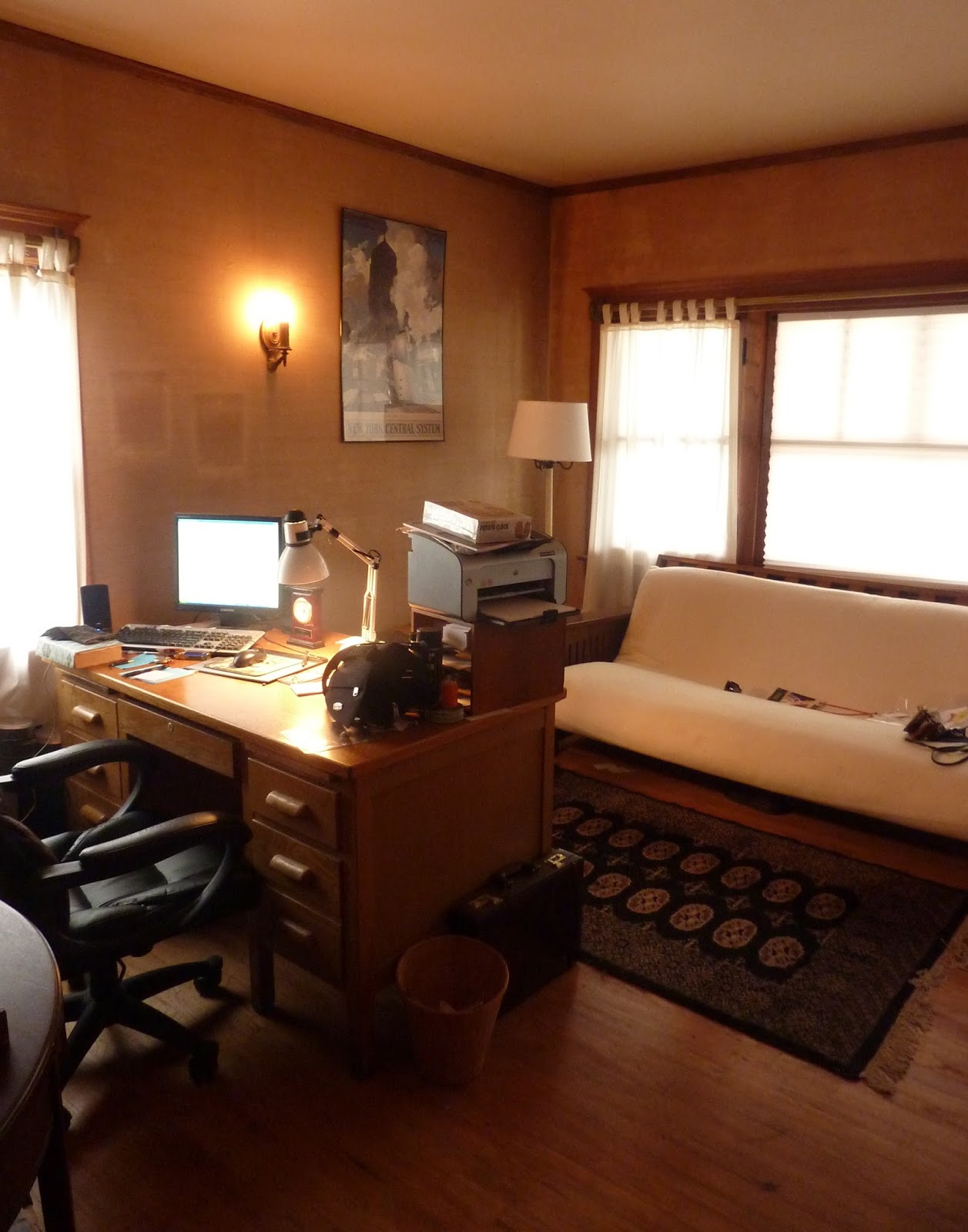
My Office when The Book of Barkley was Written -  2014

We all come home to different environments.
  For some, it's the sound of little kids squealing with delight that Mommy or Daddy are home.  It's the the clatter of footsteps like the thunder of small ponies down a trail, that is no trail, but is simply a hallway rug, worn by that repeated motion of sheer joy.

For some it's a simple "Hello Sweetie" a hug and a kiss.

And sometimes it's the blissful sound of silence after a really long day when all you want to do is eat a hot meal and have a mug of hot tea while you lay out the thoughts of the day in your favorite spot to write or perhaps watch one of your favorite old adventure movies.

The night in question was the later kind but it was going to be one of those very nights where the tea was a glass of Malbec.
Mom, come quick!  Someone pooped on the rug!

Barkley usually greets me at the back door to the garage, alerted by the door going up, with that terrifying bark that to outsiders sounds ferocious. He sounds scary, but he'll let me take a bone right out of his mouth with my bare fingers.  I'm his protector and his protected, and if I want it, it's mine.  But he'll defend to the death, that bone, from any creature of a lower, parallel plane, those that are neither protected or protector that would take what he loves.  So even with that quiet temperament that is his nature, I know he'd defend to the death, as well, my safety.

But he knows the sound of my truck and the bark takes on a different tone. I normally hear him before the door is even up, the sound, wild and faint, and incomprehensible but for its meaning. Bark!  Bark!  "Mom's Home!"

It was later than normal and when I came in - silence.  He was comfy on the couch, Brinks Barkley, sleeping on the job.
I patted him, fed him, and let him out to go potty, which he always does after he eats. I was glad his tummy was feeling OK, as the previous evening he had snarfed up a bit of greasy food wrapper that had hit the floor when emptying the trash, and I figured that might upset his tummy. But he seemed fine, just not as lively as usual.

So I poured the wine, put on some barley soup on to heat for supper, and sat down to call Partner from the couch.

We  had just said hello when:

 "Oh, Crap! Barkley threw up in the corner earlier!  I have to go".
Barkley has an ultra-sensitive stomach as far as rawhides and some people foods, even when he was youngster, unlike my last black lab who could eat a tank and then just gently burp.  So several times a year, Barkley snags some fatty food that's dropped (bacon!)  or a piece of sandwich left unattended or a paper napkin or such that is soaked with meat juice.  He then usually throws it up. He always upchucks in the same spot, if he can't alert me in time that he needs to go out, a corner of the front room between a sofa and chair. Since there's a nice rug there, I spread out a large clean towel in the spot, just in case.

Unfortunately, it wasn't barf. Other end. Poor thing,

I'm sure he tried to hold it, but couldn't.  He's never done that in the house since his first couple of weeks home as a puppy. Of course, this time, he carefully MOVED THE TOWEL OUT OF THE WAY FIRST before he tagged my floor with the latest black lab gang signs (in poop!) But I can see the doggy thought process - "Mom gets upset if I grab her clean towels off the counter so I will protect her clean towel even in my indisposition - I'm a good dog!"
Mom, I was just FOLDING these clean towels I found on the counter.

He just looked at me from a distance, as if he expected a scolding, as I cleaned it up (pointing out the large area of tile in the entranceway he could have selected instead of the carpeting, though he didn't appear to be taking notes). There is nothing quite like the look of a dog that's expecting harsh words, no different than a human that somehow knows you are angry, even if they aren't quite sure what exactly they did wrong; a sort of shocked and unbelieving sorrow.

You look at them, your heart beating strongly with the heat of the moment.  They look at you, their heart beating a hollow echo as though already retreating, as they wait for your reaction. You look at them again, weighing a hundred expedients, knowing what you need to do, and not necessarily what fatigue and emotion might prod you to do.
I went over and gently scratched his ear saying  "It's OK, you couldn't help it, you're a good dog", patted him one last time, and gave Partner a call back.

"(sigh) It wasn't barf".

"Oh, so the "Oh Crap" was literal then?"  We laughed and proceeded to chat while Barkley laid down next to me for an ear scratch, feeling fine physically, but needing the reassurance that all was well.

When people get married they take a vow of "in sickness and in health". In a way, we also do that with our pets.  Owning a pet is not cheap, even for youthful preventive care.  Then, there are always the things you don't expect, especially as they age, things that result in someone wearing the cone of shame or the expenditure of hundreds of dollars.
But you help them get better, you adjust your schedule, make doctor appointments and you offer only warmth and support.  You don't lay your hand upon them with forceful curse and belittlement. They look at you to be the strong one, the tender one. They trust you to act from your heart and not from the infinite, internal voices of human fear and angst.

Then, on those nights when you come home really, really late from work, your soul weary, the house dark, they will quietly come up to you, leaning into you, drawn from their slumber to your side like steel and magnet. At that moment, there as both your hearts beat in the silence, you realize that every measure of sickness and health was worth it.

Tuesday, June 18, 2024

The Tick of a Watch that's Not There

The night is warm, yet I'm dreaming of cold, of a windswept farm field covered in snow. In my dream, a form I could recognize yet not touch—fire in his hair, fire in his eyes. Speaking to me though I could not hear, mouth moving as if to taste—and I wake up. For a moment I don’t know where I am, then I look around, smile, and go back to sleep.

When I wake again the neighborhood is hushed. I’m not sure what time it is, as I don’t have a clock on the wall or wear a wristwatch. I have an antique clock left to me by my mother, given to me not so that I remember time; for hers was short, but to forget it. Forget it as I move out into the world, gathering the wind to propel my journey, not holding my breath to conquer it; the folly of many a philosopher and fool.

The household is quiet. the rescue Lab is snoozing in a patch of sunlight somewhere, dreaming the dreams of solar-powered dogs. Outside, the yard is perfect with the stillness of dew, the sun glinting between low branches. No dog tracks yet, no human or squirrel tracks; only a line of old trees standing with the enduring and ageless patience of static stillness, waiting for something. Perhaps they simply wait for me to venture out into the burgeoning warmth of morning.

The neighborhood slumbering, I look out; innumerable shadows on the ground, as still as if they had been laid down upon it as stencils. Sunlight is just a pencil tracing, drawing dark and light. The morning is here, now. Where I came from last night is only a distant memory. 

Back behind the trees, the sound of a train dies away to the tick of a watch that is not there, running through another day somewhere far away for now, fire in his eyes, fire in his hair. The sound hangs in the air like punctuation, the clouds curled up above in small catnaps of infinity—only my small form, and perhaps a camera, to capture them. The train moves away in unshaken pull and balance, consuming inertia itself; its desire; only a breath of steam in the cold air.


The light is soft, a cold blue fragility that speaks of shattered thought. Not quite enough light yet for photos, no tangible remembrance of the feeling; only words that gather up their own steam even as they fade away into silence as I recall another morning long ago.

We had been setting out to check on an old tree blind before whitetail deer activity started. It had been some time since we’d visited since I’d made my way out there. The woods looked ancient; evergreen trees bearing their load of snow on sagging shoulders, a few trees holding on to threadbare leaves gathered around their branches like a shawl. It had been an early snow, masking all the normal markings I would have used to find my way back to the house. As I went deeper into the woods I broke off a few small branches, small signs that I was on the right path, even as whole trees had fallen over trails I used to take.

From above a hawk dove down, rending the sky like faded blue cloth, its tattered remnants flung behind as he swooped down in search of something he needed to sustain. I’d not have seen him had I not remained totally still; his dive a brief blur, a mote from God’s eye falling from heaven.

The old deer blind was still there and secure, so I began the journey back, looking carefully to make sure I was on the right path to light and safety. From a distance, I could see the warm glow of the house. From the trees, I heard the gentle huff of a buck—a greeting, a warning, his breath clouding the air in anticipation of that which he knows he wants. I caught only a glimpse of a rack - its width indicating he had survived numerous hunts. He watched me, a Trojan with time and patience and the occasional Browning 20-gauge on her side.


On this day, though, the deer had nothing to fear from me—the dance between man and nature, the slow waltz of blood and need, stilling within me for now. That day, he and I were simply part of this same forest, one with the land. Though by my intellect and God’s grace, I had dominion over him, I would tender my stewardship carefully and leave him in peace. The recognition of freedom, the desire for life—full, rich, and red—was as conscious in me as in him, and is always there even when my higher nature slumbers. It courses through this earth and each of us, a deep red vein awaiting the divining rod of recognition.

He turned with a flick of a white tail and disappeared into the shadows, deeper into hundred-year-old woods. I wished I’d had a camera to capture that, to capture all that I can’t see and can’t remember later; so much here beyond the grasp of anything born or invented. Perhaps I could find words for it, if only silently; the apotheosis of our need voicing a thousand avatars. - Brigid

Saturday, June 15, 2024

From a Flaming Apron, a Classic Firearm is Born


Christian Friedrich Schonbein (Oct. 18, 1799 - Aug 29, 1868) was a German/Swiss chemist who is well known for inventing the fuel cell in 1837, but it is another of his discoveries, done by accident, that impacted firearm design and led, in part, to the invention and production of a seemingly simple little pistol that lives in the gun-safe at the Range.
The story is as follows. Although his wife forbade him to do so, Schonbein liked to experiment in the kitchen (and NOT with flour, sugar, and salt).  It is said that on a day back in 1845, he spilled a mixture of nitric acid and sulfuric acid.  Using his wife's cotton apron to clean up the evidence, he hung her apron over the stove to dry, only to find that the cloth spontaneously ignited and burned so quickly it was as if it had vanished. (Honestly honey, I don't know WHAT happened to your apron). What he had done was convert the cellulose of the apron with the nitro groups (from the nitric acid) serving as an internal source of oxygen. When heated the cellulose was completely and suddenly oxidized.
Though it was by accident, the discovery of a method of production of guncotton (nitrocellulose) had occurred.  A crude version of nitrocellulose had been discovered in 1838 by Theophile Pelouze, but he apparently failed to follow up on his initial observations so Schonbein is credited for the discovery. No fool, Schonbein recognized the possibilities here  At the time, the black gunpowder which had been around for hundreds of years, exploded producing thick black smoke. This has disadvantages beyond giving away the gunner's position and obscuring their view of the battlefield. It also produced by-products which essentially "clogged up" the firearm just as it fouled canons.

Nitrocellulose was perceived as a possible "smokeless powder" and a propellant for artillery shells, and apparently, the name "guncotton" stuck.

Schonbein patented his process, giving the manufacturing rights to John Hall & Sons in Faversham. Unfortunately, guncotton was inherently chemically unstable, burned readily, and exploded easily (much like today's modern redhead) so attempts to manufacture it for military use resulted in several factory explosions, dozens of deaths. and general mayhem.
It wasn't until after the death of Shonebein that French chemist Paul Vielle found a way to stabilize guncotton into successful smokeless gunpowder. He called his invention "poudre blanche" or white powder. It burned much faster than black powder and produced comparatively little smoke, hence the "smokeless" moniker.

(Note: in 1891, James Dewar and Frederick Augustus Abel also were able to transform gelatinized guncotton into a relatively safe mixture, called cordite.  The name came about as it could be extruded into long thing cords before being dried.)

How does this little history lesson tie into the Browning 1900?
Several attempts to create a self-loading (automatic) weapon were made before smokeless powder arrived on the scene.  None of the efforts were truly viable because of the heavy residue of black powder which obviously impacted mechanical function, and not in a good way.

With smokeless powder - that changed and several people began working on designs for self-loading firearms, including Mannlicher, Bergmann, and Mauser.  The early models had limited sales and were mostly intended for military use.

Along comes John Moses Browning - a man who learned to repair guns in his father's shop before he learned to read and write.  He filed his first firearm patent at an age when most of us were still in college, and through the next decade followed it with another dozen or so patents on various self-loading weapons, both recoil and gas-operated.  In 1896 he signed a contract giving Colt's the right to manufacture several of his automatic pistol designs for distribution in the US and Canada.  At the time, it was widely believed that Colt was simply acquiring the right to protect sales of their revolvers, for the established market for self-load pistols was not yet established in the United States.
That would soon change.

One of Browning's patents was U.S. patent 621,747, covering the final design for what would be the single action1899/1900 FN Browning. I believe it is the first production handgun to use a slide.

The design was said to have been presented to arms manufacturer FN  Herstal (Fabrique Nationale de Herstal) in 1898 with production in their Belgium facility shortly following under the designation Modele 1899. The FN engineers who produced this firearm based on Browning's design were astounded by the reliability of the piece when it fired round after hundreds of rounds without a single failure to feed or eject, remarkable in the day. The contract Browning signed with them was said to forbid the sale of the firearm in North America, where Colt already had the right to sell Browning's design.  It is perhaps for this reason that there are not a lot of these guns in the US today as in other parts of the world. 
In 1900, an improved design with a shorter barrel and wider grips was produced as the M1900. These designations were applied retroactively after FN started to manufacture other Browning pistol designs, so initially, the M1900 was marketed simply as the "Pistolet Browning".  The gun was manufactured for over 10 years, with some 720,000 + units produced.

Its owners included President Theodore Roosevelt, who is said to have kept a pearl-handled 1900 in the drawer next to his bed.  It quickly earned a reputation for ruggedness and reliability and was soon adopted by Belgium as its service sidearm.  The Belgium Military had requested that their gun have a frame reinforced more than the model 1899.  Therefore, the reinforced portion of the 1900 frame above the trigger guard extends ALL the way around to the rear of the trigger guard, and all the way to the ejection port on the right side, this area being made several thousands of an inch thicker than the 1899.  If you compare it closely to the 1899 it also has slightly larger, thicker grip plates.

Over the years it saw employment by the military in a number of countries, including Austria-Hungary, Greece, Russia, France, and Germany.

In appearance, it lacks the streamlined shape of its follow-up, the Model 1910 but it has numerous features that contributed to its popularity.  Reliability was one of them. The recoil spring is enclosed in a channel above the barrel and also functions as the firing pin spring.  This design will set off even the most stubborn primer.

It also has a separate breech-lock that attaches to the slide by means of a couple of large-headed screws (unlike subsequent semi-auto's that hit the market.) The safety is a small lever located on the left side of the frame.  Labeled "FEU" (fire" and "SUR" (safe) it's easy to flick to the preferred position (though you could get markings in German and English by special order for sale in other countries.


Holding 7 rounds of  7.65 mm (.32 ACP)  the magazine is secured by a fairly small heel-type catch. Grips are checkered hard rubber and depending on where the gun was manufactured, may display the initials "FN" below an engraved image of the gun itself or imply "FN". On the Range firearm, the markings on the barrel and frame are FN inspection and Belgian government Liege proof house marks, required by law on all firearms produced in Belgium.
Gunsights are about as basic as you get with a non-adjustable rear notch and rounded blade front The rear sight is unique in that there is a rounded pin that will rise up to block the notch when the trigger is pulled on an empty chamber letting the shooting know the pistol is unloaded, as unlike many firearms the gun's slide does NOT remain open after the last shot

It's surprisingly easy to field strip and clean, having a minimum of parts.

Assembled, at 6 and 3/8 inches long with a weight of just 22 ounces, the 1900 is easily concealed. The frames are hand-ground by machinists and may vary sight in shape or length. Drawing from concealed is aided with round contours that make it easy to draw from a pocket or holster without it catching on anything. It didn't achieve great popularity in the States, perhaps due to the popularity of the 1903 Colt, but it was well regarded elsewhere, with copies even made in the Middle East and China, where the pistol was held in particularly high esteem.
So, the Range Browning 1900 is neither complex, nor rare, but I'm glad it is part of the collection.  It's not going to win me any awards with one-inch groupings but it's a reliable and well-built little piece of history to hold on to and to pass on to the next generation.

Sunday, June 9, 2024

Crossing the Lines

I watched a neighborhood kid out on his bicycle yesterday, his mom walking behind him. The child had on a jacket, gloves, a helmet, and knee pads. It was about 62 degrees. Put my brother and me on such a bike all those years ago and we’d have been bareheaded, barehanded, and probably in our shirtsleeves, Mom at home knowing we’d come back when we got hungry.
 
But my Mom, being a former County Deputy Sheriff, knew of the dangers of the world and we were always in the company of other kids or a friend’s older sibling, for even in small-town America a generation ago children could be prey. We rarely heard of such things before the Internet, but crimes against children occurred. My folks didn’t push us into adulthood too soon, but they also taught us that the world is not necessarily a safe place, that with risk sometimes comes pain, and with danger there comes both exhilaration and consequence.

I’d not trade that upbringing and the little scars that remain on me from it for anything. There’s the one from a nasty cut on my foot playing cowboys and Indians barefoot on unfamiliar grounds. There is another where I got pelted with a piping hot stink bug from the Creepy Crawlers (we weren’t protected from either the sun or heated toy appliances back in the day). There is a very faint line down my thumb from jousting with ink pens in honors math. 

Good times. 

It wasn’t long before the freedom of those bicycles was replaced with the freedom of a car. My first one was an antiquated 1964 VW Bug, very cheap in so much that it was older than dirt and slower than molasses but it was mine.
I remember those days as if it were yesterday; driving way too fast past streams that ran out of the higher elevations, veins that let the mountain bleed. The water rushed, tumbled, and raced to its destiny, to be drunk deeply or left to stagnate in a secluded pool. The sky would break out in articulate warmth there on those last days of the conceit of winter.

It was the end of the ’70s. It was when I learned about freedom and speed, the year I learned to drive. It was the year in which I first learned about the hard outcome of choice. I was always captured by movement, machinery, and speed; and now there were keys in my hand, a vehicle just waiting to take all of our compressed heat and explode it into sound. I started slowly, learning the basics, and then to drive in snow, gradually picking up speed. It wasn’t long before my friends were driving with bigger, faster cars, and the speed would increase. We even found a road where, if you hit this rise just so and at a certain speed and angle, you could go airborne like The Dukes of Hazard.

We drove off into the hills with that sense of immortality that only the very young and the very stupid seem to have. Driving without fear, without thought, sacrificing only some rubber and the occasional fender to the gods of the roads. We were teens; there were tears and drama, hookups and breakups. It was the season of curving roads and youth; where we were immortal with no adult responsibilities to block that open road.


On those free afternoons, we’d pile in the cars, heading up into the hills to seek the source of the water and ride it down. Cresting the hills with windows open, the wind as fluid, hot, and hard as love, a swift current that will pull you under to drown, gasping. We’d drive for miles with just the sensation of rushing space as deep as the water. We’d drive until dark, unrelenting and unrepentant, curfews nipping at our heels, leaving in our wake only the sound of crickets and the breathing of night taking in the remnant smell of high octane.

Soon enough there would be graduation and college, likely sans car to cut expenses. These days would vanish with a befitting and hollow sound, which would fall for only a moment upon us, with the dreadful hush of motion stopped too abruptly to mourn. Adulthood looming; where vehicles became simply transportation again, something to shuffle kids around, a conveyance to work. We could not comprehend that someday, for many, life would become an emptying suitcase of enthusiasm. We swore we would NEVER buy a station wagon.

We had our future, we had our past; and in those moments, as wheels hit the pavement and gravel flew, sometimes we had both at once. It was once said in an age-old axiom that an object cannot occupy two positions at the same time. Perhaps in those microscopic realms beyond any conceivable experiment of physics, it will be possible somewhere, there in the darkened edges of our life where quantum mechanics reaches out to the human world. And we could be in two places at once. Or occupying the same position at two different times. Or fervently wishing we could.
 
I was working part-time at the local funeral home after school and on weekends; just someone in the building after hours in case a family came in, making coffee, and doing light clerical work. My friends teased me, but they teased me as well when I did career day with the forensic pathologists. The call came in late, a teen in a small car not unlike mine hit head-on after they crossed the center line on a curve marked “no passing” to pass someone slower than their patience. There was probably only time enough for an intake of breath and hands flung up over his face as if he could hide from that weighted shadow of choice which in that moment he had sacrificed himself for.

I was there when they brought him in. Though I didn’t know him personally, there were two high schools in town and he attended the other one, I had more than one evening in his company there at the funeral home and I wondered if he had second thoughts about his decision as he slept suspended within the hard vault of his regret. Would he have made the same choices if he had known? We’ve all had days like that when simple things went awry, plans made that mattered little to you, but mattered much to others. Things said, bridges burned, moments that repeated themselves for weeks or months in your head. If only I’d done this, if only I’d said that. Moments in which you wish you could turn time back on itself as if you’d never been there.
After that local tragedy our parents lectured us about the dangers of speed, about road signs, and why they are there. Some kept their kids grounded, not allowing them to drive at all. Certainly, such a place is safer; where no taint of desire affects debate and actions aren’t directed by cloudy agendas. Still, it is a world flat and colorless as tap water. It’s a world where, whether hiding at home or out with the wind in your face, we pass an anniversary without awareness. That of our own demise. 

My Dad did not lecture, he knew what I’d seen was its own lesson. In a life fully lived we engage our fate deliberately; we speak the words we may later regret, but we have to say them. We engage life as an indefatigable opponent that others will wish to tiptoe by so as not to awaken it. We risk our necks and we risk our hearts. So although I slowed up it was not by much. But I didn’t make it to adulthood by not scaring the wits out of myself, first in a car and later in an airplane as I took flying lessons; watching the earth go perpendicular and rush upwards as I hung on that last strand of lift above the deep yawn of gravity.

We’ve all been there, a carefully planned day meant to be spent in quiet order when suddenly fate reaches out and places its hand on your shoulder; sometimes a reminder, sometimes an order to go home. The Earth is full of fight and friction; but when that moment happens the world hangs motionless in that instant, a cooling mass in space, even as you articulate your sudden surprise.
Sometimes you get lucky and survive, but the event leaves physical scars. But for most, the scars can’t be seen and can only be traced by inscrutable fingers, there in the dark while time ticks a reminder of battles sometimes lost. I learned that as a teen as I dusted the coffins of those who had lost their particular battle. I learned later as I studied the bones and pieces of life past and present that fate is and always will be ravenous for the flesh of the foolish, rarely frustrated or even thwarted. It sits and waits with great patience, for yesterday and today are the same to it, indivisible, timeless. Sometimes it slumbers under God’s stroking hand as he watches like a parent from a distance when we do something particularly foolish; sometimes it wakes up to solitary hunger that it will soon act upon. 

I remember the last time I got a late-night call out, the phone rang well after midnight. I got called in to work. The work I do is not elemental to this story, one to tell perhaps when I retire, but it’s a job of odd hours and often tragedy. It’s what I believe I was always meant to do, I think as I grab my gear and warm up the big black truck sitting in the driveway. The cold echoes off the pavement in which the only shadow is its form. It’s a large extended-cab black 4 x 4 truck.

As I climb in, I catch a reflection in the side window and see my own face. The face is of an adult yet overlaid with the plaintive need of the youth in all of us, seeking release, wanting to leave a parent’s watchful eye and just feel the world soar past. I silently open the truck door as if sneaking out and fit my form into the leather seats, an old familiar embrace that no amount of days can change. With a shuddering tremble of a racehorse at the gate, the truck backs out into the drive. 

I have no curfew, just my wheels and miles of road interspersed with the angular cuts of barren fields, ringed with blue sky; windows rolled up as a futile barrier to the outside elements. As the truck moves onward, rain begins to fall; an isolated thunderstorm. I watch the side of the road as ghosts of those who risked all wave at me from tiny markers that note their passing, and my foot comes off the gas, the water falling with astonishing clarity. You need to look closely as you balance the deep satisfaction of taking a risk and winning with the need for caution; for weighing all the odds, the options as well the infinity of what you are launching yourself into is not easy. You take the risk of losing your life or losing your heart, both with consequences, both risks sometimes worth taking.

The water hits the hood and spreads, swimming like dew before a rush of air. One moment life and form, the next melting indistinguishably into the wind. Ahead are only the miles, with nothing to do but take in the occasional broken road sign and empty barns breaking up those small patches of cleared earth, whorled with hard work, small square islands of grain. The air is dense with the white smoke smell of brittle leaves, lying still like snow on the ground, fire in my heart. Up ahead the horizon, up above an inscrutable sky, desolate above the land over which it looms. On the seat is a heavy flashlight, there if I need it, one less shadow to flee through and from.

I’m wondering if this rig will go airborne if I hit the rise just so but I don’t, knowing when it’s time to speed past that demarcation between what I should do and what my heart tells me to do. Calculating the miles, the speed, the wind, the traffic; weighing the risks of life versus loss. The passing landscape is bounty and beholder, the open road its postulate. The asphalt flows past, as do the signs of feed stores, of gas stations, of tiny fixed crosses there by the road. Reminders that despite our freedoms there are lines that are written into infinity. Once you cross them you can never go back. - Brigid

Sunday, June 2, 2024

Field of Dreams

Why does it seem that when we set out to do something, the actuality of it seems forever away, and when we're finished, we look back wondering how we did it at all.

 Everything we touch, hold, use, or love---was once just an idea. Had the person who first envisioned that thing thought too keenly as to his or her chance of success, it may have never happened at all. My writing started with blog postings, a way to unwind and work through things that were painful, it was a way to view my life and actions as a third party, which sometimes is painful in its revealing of the past and past actions that weren't good choices.

 People said "You need to write a book" and I put it off with the excuse of "after retirement". Part of it was (insert Dr. McCoy voice here "Jim - I'm a doctor, not a writer!") But honestly, the thought of writing an entire book wasn't just daunting; it was flat-out frightening. I pictured it in one of those $5 bins at the bookstore, spent brass of the heart that no one wants to pick up. I pictured the sound of the critic's crickets, or worse---their scorn.

But I did it anyway. 7 books later, 5 #1 bestsellers, 3 major literary awards and I still show up at book signings looking around like I expect a “real author” to show up, then I just dive into the cookies, pour a cup of coffee, and share my dreams. Without dreams, there is nothing to do but wait to die.
My parents fell in love as teenagers. World War II interrupted their wedding plans but they wed on his return from England, so many years later. Dad told very few stories of those times. All I have of those lost years is a stack of letters, written in the years he was overseas, carefully held together with a ribbon. Reading them feels a little like eavesdropping, as you can almost hear the words as they formed---heartfelt, intimate.

I open one; it is just one single page, and I think of the way their day stopped at the brink of it. In these letters bridging the time and distance they had to be apart, there was talk of how much they missed one another; of how their families were faring; of good coffee and how Dad missed vegetables from the farm; of burning heat and a cold on the field that would murmur to your very bones. There was playful affection, there was unstated passion and stated promise. Some were in Mom's flowery script, the rest in Dad's meticulous, indomitable hand. "Is everyone there well?" Mom would ask, and Dad would reply that they were, though some were now only well beyond Lamentations.
Dad never imagined that he would not come back, he never told himself that they would not be married, would not have children, would not make a life. Even in times of great battle, he held the final prize in his hand, never doubting that it would come to be. He watched over that dream as our Father in heaven watches over us, his creation shaped out of the primal absolute that contained nothing and all, knowing we are equally as capable of being ruined and being saved, but believing we will be saved, as to believe anything else is to perish. 

We all have our dreams, just as we all have our fears. My husband was, and is, a gifted musician, a prodigy as a youngster. He performed with a symphony orchestra in Austria before he was 18, offered a university scholarship to study music. He wanted to be an engineer. He still plays, well enough to make me cry. But his passion is creating---inventing things out of form and void, and steel and noise, things that touch his brain and his heart---for what the heart holds becomes our only truth.
I talked to my father every night in his last years. He did a lot in his life, Golden Glove Boxer, Veteran, Freemason, father. One night I asked him what was his biggest regret, and what was the one thing he was glad he did. What he said was his regret was: "That time in my 20's I spent $5 on hair growth tonic from a bald barber", and he chuckled. What he said he was most happy for surprised me until I understood what it meant. He said. "I'm glad I loved and lost Gracie" (my mom).

But it was not because he was the one that physically remained after she died, but because he was glad that he had followed his heart, not his good sense. Because if he had not, she would not have become the one he had to grieve over, because he chose to abandon the idea of them.

Those of us who have lost a furry family member understand. Though we hate that deep hurt of loss when it is their time to leave us, we have no regrets about the months or years with that soul, if offered a choice now to change the experience. So many precious memories; so much love, we would not have experienced if we'd not dare to dream that dream, of making them part of our lives. So as you look around your life this day- think of things you'd like to hold onto, picture flesh and blood, wood or glass, cat or dog, paper, or plastic. Do not think about all you will risk to get it. Do not think about how long it might take, or even if it will be what you expected. Do not think about what happens if you get it and lose it one day.

I look at a photo of my parents on their wedding day. Dad in uniform, my mom wearing a beautiful dark suit. They look both innocent and immortal, even if slightly amazed to be saying those vows after a great War separated them for years.

On my table, I see a violin, worth more than my first home. I carefully put it away, for in a few hours my husband will be home and that table will be littered with all manner of tooling bits and mechanical drawings and plans. They will lie next to a small pile of books to be autographed and mailed for an animal shelter auction. Across the floor are strewn countless toys of a new rescue dog, one surrendered because she wasn’t physically “perfect,” I look at her bowed legs and funny gait, and all I see is her heart (and the remains of a slipper).
I don’t have the vista of the open plains that was to be my dream home, I have the skyline of a major city. Yet, the sun still dawns just the same here, with a first ray of light out of the east that darts fleeting and faint through uncertain clouds, a portent of daylight and thunder. I wouldn’t trade this view of life for any amount of planned perfection or the promise of only sunny days. All these things are objects that print the often-silent mold of our dreams and desires, as easy to be ignored as small fairy feet, when they are magic indeed.
Brigid